
MATERIALS TESTING
Tensile Test Elongation
Methods, and Reliable Testing Solutions
About
Tensile Test Elongation
Tensile test elongation is one of the most important indicators of how a material behaves under stress. It refers to the increase in length of a material sample when subjected to tensile force until it breaks or yields. For engineers, manufacturers, and quality control professionals, this property helps determine whether a material can withstand real-world applications where stretching, pulling, or tension occurs.
In simple terms, elongation tells us how much a material can stretch before failure. It reflects the material’s ductility, toughness, and flexibility. That’s why tensile and elongation test methods are widely applied in industries ranging from packaging to medical devices.
ELONGATION & TENSILE
The Definition of Elongation in Tensile Test
The definition of elongation in tensile test is usually expressed as a percentage increase in the original length of a specimen. It is calculated as:
Elongation (%) = (ΔL / L₀) × 100
- ΔL = change in length after testing
- L₀ = original gauge length
For example, if a 100 mm sample stretches to 120 mm before breaking, the elongation is 20%. This simple parameter is critical for comparing different materials or batches to ensure consistency in production.
Tensile and Elongation Testing
Importance of Tensile and Elongation Testing in Material Science
Tensile strength and elongation test data provide insights into a material’s mechanical behavior under stress. Key benefits include:
01
Quality Assurance
Verifying that materials meet specifications for durability and performance.
02
Product Development
Guiding the design of components that must withstand mechanical loads, such as automotive parts or medical implants.
03
Failure Analysis
Identifying weaknesses in materials that could lead to premature breakdowns.
For example, in the textile industry, ASTM D2256 tests assess yarns for breaking force and elongation, ensuring they can endure weaving or knitting processes without damage. In metals, tensile vs elongation curves reveal yield strength, ultimate tensile strength, and elongation at break, which are crucial for structural applications.
Cell Instruments’ expertise in customization ensures that elongation testing machines are tailored to unique material requirements, from adhesive tapes to composite fabrics.
ELONGATION TESTING MACHINE
How an Elongation Testing Machine Works
An elongation testing machine, also known as a tensile tester, subjects a specimen to controlled tension until failure.
- Sample Preparation: Specimens are cut to standardized dimensions (e.g., dumbbell shapes for plastics) and conditioned to avoid environmental influences.
- Mounting: The sample is clamped into grips, avoiding slippage or damage using padded surfaces.
- Testing: The machine applies uniaxial tension at a constant speed, measuring load and displacement.
- Data Analysis: Software calculates key parameters like elongation percentage, tensile strength, and modulus.
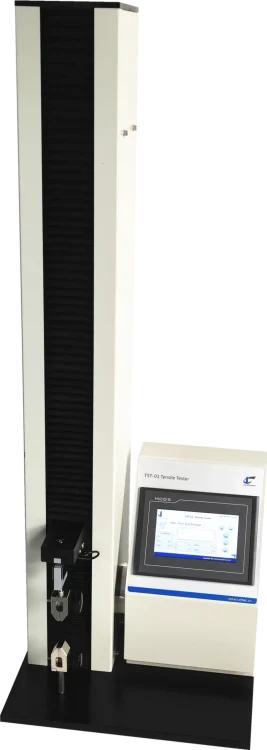
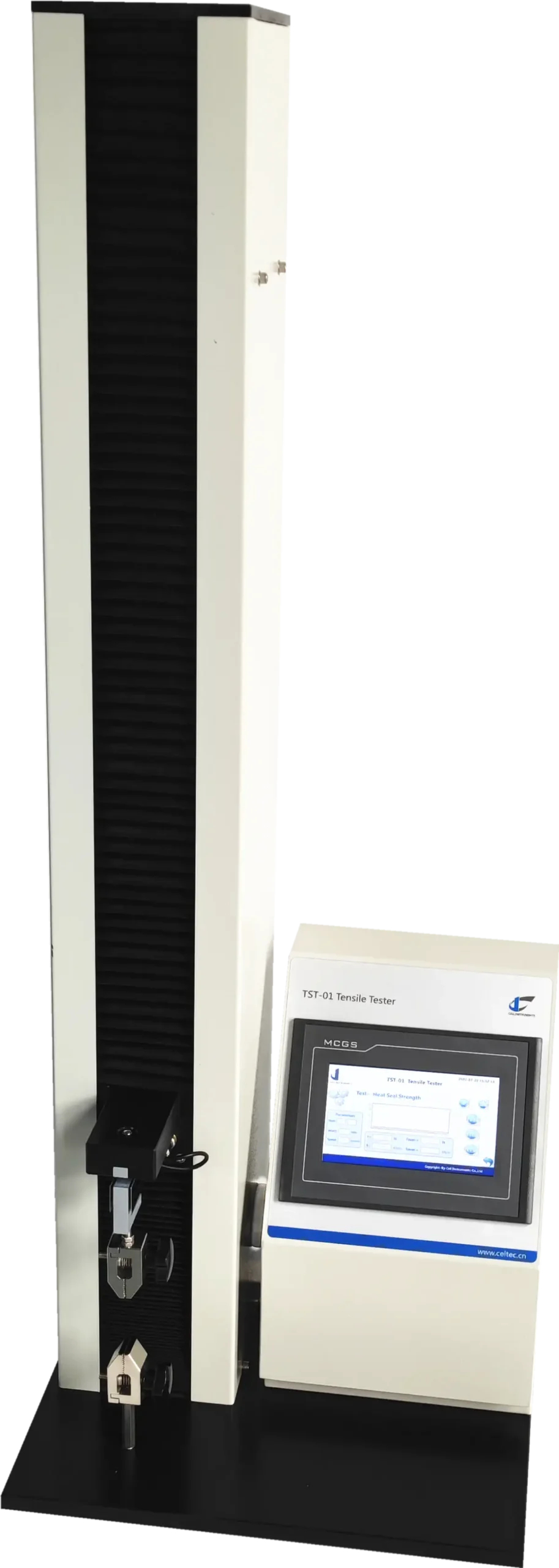
Advanced systems, like Cell Instruments’ TST-01 Tensile Tester, integrate PLC control and HMI touch screens for precise speed and displacement adjustments. Features like automatic returning and limiting devices enhance safety and repeatability.
Tensile and Elongation Testing
Key Factors Affecting Tensile Elongation Results
Varios factores influyen en los resultados de las pruebas de tracción y elongación:
01
Material Composition
Alloying elements in metals or polymer chains in plastics impact ductility. For example, annealed copper shows higher elongation than cold-worked versions.
02
Specimen Geometry
Dimensions like gauge length and width affect strain distribution. Standards specify ratios to ensure consistency.
03
Test Speed
Excessive speeds can overestimate strength and underestimate elongation. Cell Instruments’ testers offer adjustable speeds (1–500 mm/min) for compliance with standards.
04
Environmental Conditions
Moisture (e.g., wet testing for textiles) and temperature alter material behavior.
Calibration and operator training are essential to mitigate these factors. Cell Instruments provides support to maintain testing integrity.
Applications of Tensile Test Elongation in Industries
Flexible films require high elongation to resist tearing during transportation. Cell Instruments' TST-01 measures seal strength and puncture resistance.
– Packaging
Sutures and implants must balance strength and elongation to comply with physiological stresses. ASTM D2256 tests yarns for surgical applications.
– Medical
Fabrics for protective gear need controlled elongation to avoid excessive stretching.
–Electronics
Adhesives and coatings are tested for elongation to prevent cracking under thermal cycles.
– Electrónica
Case studies show that automated elongation testers improve efficiency in high-volume production environments.
TENSLIE ELONGATION TESTER
Choosing the Right Elongation Tester
- Force Capacity: Machines like the TST-01 offer ranges from 0–500N, suitable for films and soft materials, while higher capacities (e.g., 100 kN) test metals.
- Accuracy: Precision ball lead screws and encoders ensure displacement accuracy to 0.01 mm.
- Software Features: Data export via RS232, real-time graphs, and customizable reports enhance analysis.
- Compliance: Adherence to ASTM, ISO, and GB standards guarantees reliability.
TST-01
Cell Instruments TST-01 Tensile Tester
01
TST-01 Tensile Tester
At Cell Instruments, we recommend the TST-01 Tensile Tester for accurate tensile and elongation testing. This versatile machine supports various applications, from films and adhesives to medical packaging materials.
Key advantages include:
- PLC and HMI control for stable, user-friendly operation.
- High precision with 0.5% FS accuracy and 0.01 mm displacement resolution.
- Wide testing range (0–500 N) with customizable strokes.
- Multiple fixtures compatibility for tensile, peel, and deformation tests.
- Optional data output and microprinter for detailed reporting.
With these features, the TST-01 stands out as a reliable elongation testing machine, helping manufacturers meet stringent quality assurance standards.
Tensile test elongation is more than just a number—it is a critical measure of material quality and reliability. Whether evaluating packaging films, adhesives, or medical device components, this property ensures products meet performance expectations. With advanced solutions like the Cell Instruments TST-01 Tensile Tester, businesses gain accurate results, strong data reliability, and compliance with global testing standards.
– Cell Instruments
Frequently Asked Questions
1.What is tensile test elongation?
Tensile test elongation refers to the percentage increase in a material’s length when subjected to tensile force until it breaks. It is a key measure of ductility and flexibility in materials like films, adhesives, textiles, and packaging.
2. How is elongation measured during a tensile test?
An elongation tester or tensile and elongation testing machine grips the sample and applies controlled tensile force. The system records the extension in length compared to the original gauge length, and the elongation percentage is calculated.
3. What is the difference between tensile strength and elongation?
- Tensile strength is the maximum stress a material can withstand before breaking.
- Elongation is the strain or percentage length increase before failure.
Both are typically reported together in a tensile strength and elongation test for complete mechanical evaluation.
4. Which industries need tensile and elongation testing?
Industries such as packaging, food, pharmaceuticals, adhesives, textiles, and medical devices rely on tensile and elongation tests. These tests ensure product reliability, compliance with standards, and safety in real-world use.
5. Why choose the Cell Instruments TST-01 for elongation testing?
The Cell Instruments TST-01 Tensile Tester offers high precision, PLC+HMI control, adjustable test speeds, and compatibility with multiple fixtures. It is an ideal elongation testing machine for companies needing reliable results across films, adhesives, medical packaging, and more.


Get in touch
No. 5577 Gongyebei Rd, Licheng, Jinan, 250109, Shandong, P.R.C.
trade@celtec.cn
+86 185 6001 3985
 EN
EN  AR
AR  BG
BG  CS
CS  DA
DA  DE
DE  EL
EL  ES
ES  ET
ET  FI
FI  FR
FR  HU
HU  ID
ID  IT
IT  JA
JA  KO
KO  LT
LT  LV
LV  NB
NB  NL
NL  PL
PL  PT
PT  RO
RO  RU
RU  SK
SK  SL
SL  SV
SV  TR
TR  UK
UK